Introduction: Small Store, Big Vision
In the cutthroat atmosphere of local retail, small grocery stores sometimes find themselves at a loss in keeping their customers content, since many of their customers. usually attracted to supermarkets and big national discount stores turning to online apps for grocery delivery. However, in one little community in Jaipur, one small grocery store showed that if you use thinking and digital tools smartly, you can actually rewrite the rules of success in retail.
This is the story of Annapurna Grocery, a once small family-run local grocery business, that changed its fortunes, using a customer loyalty program that increased its number of visits in the store, increased the number of repeat visits, and created a community of buyers who returned regularly – all in a matter of months, without going outside the store's community playbook.
Chapter 1: The Struggles of a Local Grocery Store
Prior to its transformation experience, Annapurna Grocery was enduring most small businesses' everyday challenges:
- Increased competition from online grocery apps that included Blinkit and BigBasket.
- Pixie-like margins on daily essentials/products.
- Inconsistent traffic or buyers entering the store.
- Very little brand recall, even though the service was good.
Owner Ravi Sharma had inherited the store from his father and knew that times had changed and he needed to change. “Our regulars were shopping ‘online, or through an app, and they weren’t going there because of price, they were going there because it was easy,” he said.
That pretty much altered everything. He did not want to compete on price or discounts, instead he wanted to compete on relationships, and reliable service, which has always been the cornerstone of service for successful local stores.
Chapter 2: The Spark — Learning About Loyalty Programs
In 2022, Ravi attended a local business seminar organized by a small-business association in Jaipur. One session focused on “Building Customer Loyalty Through Reward Systems.”
The idea was simple: reward customers for coming back.
Ravi thought, Why can’t a small store do what big supermarkets are doing? He decided to try it — but on his own terms.
He wanted something simple, affordable, and easy to understand for customers who weren’t tech-savvy.
Chapter 3: Setting Up the Loyalty Program
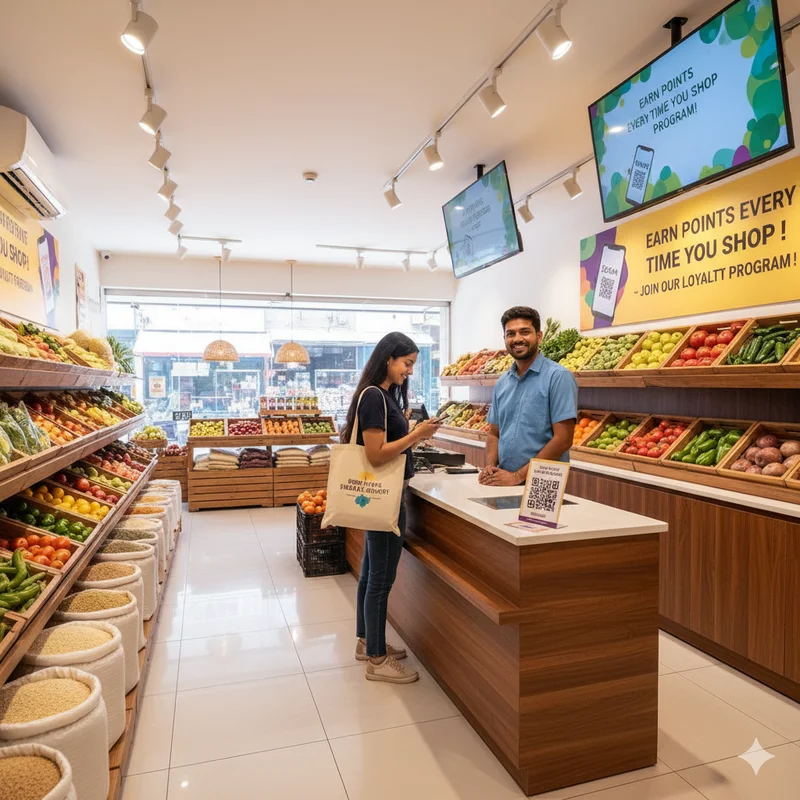
Ravi partnered with a local digital consultant who helped him launch a QR-based loyalty program. Here’s how it worked:
- Every ₹100 spent = 1 reward point.
- 10 points = ₹10 off the next purchase.
- Customers received a WhatsApp message with their updated points after every visit.
- Points never expired, creating long-term retention.
He also designed a catchy slogan that appeared on banners, bills, and carry bags:
“Earn Points Every Time You Shop at Annapurna Grocery!”
Within weeks, curiosity grew. Customers started asking, “How do I join?” — and the store began capturing customer data like never before.
Chapter 4: Going Digital With LocalShouts Support
To make the program more visible online, Ravi listed Annapurna Grocery on LocalShouts (https://www.localshouts.com). The platform helped his store appear in local search results, share promotions, and get featured in nearby recommendations.
By integrating his store’s loyalty offer into his LocalShouts listing, Ravi could highlight “Join our rewards program and earn points every time you shop!” on his profile.
That listing brought in new customers who discovered the store while searching for “grocery store near me Jaipur” — proving that even a small business could leverage digital visibility.
Chapter 5: The Results Begin to Show
Within three months, Ravi started noticing measurable improvements:
Within just three months of introducing the loyalty program, the business saw notable growth. Average monthly customers increased from 350 to 550, while the proportion of repeat customers rose from 40% to 70%. Monthly revenue jumped from ₹1.2 lakh to ₹1.9 lakh, and Google Reviews climbed from 15 to 65, with an impressive 4.8-star average rating.
More importantly, customers stopped switching to online apps. They began feeling emotionally connected to the brand — not because of discounts, but because of recognition.
Chapter 6: The Human Touch Behind the Strategy
The loyalty program wasn’t just about points. It was about personalization.
Ravi started sending messages like:
“Happy Birthday, Meena Ji! Get 50 extra points on your next purchase.”
“It’s been a week since your last visit — your reward points are waiting!”
He didn’t use complex CRM tools — just a simple WhatsApp Business account, a spreadsheet, and consistency.
These thoughtful gestures made customers feel appreciated. “It’s not just about saving ₹10 — it’s about feeling noticed,” one customer said.
Chapter 7: Word-of-Mouth and Community Growth
Before long, news of Annapurna Grocery spread throughout the neighborhood. Friends told friends. Families began purchasing all of their monthly supplies at Annapurna Grocery to maximize their points. To encourage ongoing momentum, Ravi rolled out weekly challenges:
“Double Points Wednesdays”
“Refer a Friend and Earn 20 Points”
“Festive Bonus - 50 Points Towards Diwali Shopping”
By the time Diwali 2023 arrived, foot traffic covered over three times that compared to the previous year.
Chapter 8: Expanding Beyond the Neighborhood
Encouraged by their success, Ravi began offering delivery service for loyal members only. Customers could now simply text their order via WhatsApp and redeem points for products that were delivered online! Also, Ravi partnered with LocalShouts (https://www.localshouts.com/) to push out his “members-only deals” and tell other customer success stories. This feature not only added legitimacy but also helped attract engaging customers from outside of the county. Currently nearly 40% of new customers find out about Annapurna Grocery through online sources - unfathomable just a few years earlier.
Chapter 9: Turning Data Into Insights
Through his loyalty program, Ravi gained valuable data:
- Which products sold the most.
- Who his top 50 loyal customers were.
- When traffic dipped during the week.
He used this information to run targeted WhatsApp campaigns:
“Your favorite brand of basmati rice is on discount this weekend!”
These personalized messages led to better conversions than random offers — because they were based on customer behavior, not guesswork.
Chapter 10: The Real Impact — Trust and Stability
The real magic of Annapurna Grocery’s transformation lies in customer trust. Shoppers no longer see the store as just another grocery shop; it’s part of their daily life.
Regular customer Sunita Devi says,
“I could order online, but I prefer buying from Ravi Bhaiya. I know he values my loyalty and gives me the same respect every time.”
The loyalty program turned a transactional relationship into an emotional one — the secret ingredient behind repeat business.
Chapter 11: Overcoming Challenges
Not everything went smoothly. Ravi faced challenges like:
- Customers forgetting to redeem points.
- Occasional system errors when scanning QR codes.
- Managing manual data entry at first.
But he learned fast. After feedback, he simplified the system, printed “Points Summary” on every bill, and automated updates using a basic loyalty app that integrated with WhatsApp.
His persistence paid off — loyalty participation rate jumped to 85% of active customers.
Chapter 12: Growth by the Numbers
By mid-2024, Annapurna Grocery had achieved results most small stores only dream of:
Between 2022 and 2024, the business experienced exceptional growth. Monthly customers increased from 350 to over 900, and the repeat customer rate more than doubled from 40% to 82%. Annual revenue nearly doubled as well, rising from ₹14.4 lakh to ₹28.6 lakh. The company also gained over 650 active loyalty members and achieved more than 8,000 views on LocalShouts, greatly boosting its online visibility.
The loyalty program wasn’t just a marketing idea — it became the core of business growth.
Chapter 13: Lessons for Local Businesses
There is much to glean from Annapurna Grocery's experience as a local entrepreneur. Here are the top lessons:
1. Start small, but start: You do not need to incur expense on various software. Initiate a simple points system using WhatsApp and receipts. The simpler the system, the easier it will be to establish trust.
2. Reward behavior, not just purchases: When a customer has a birthday, gets a promotion, or refers to a neighbor, recognize those actions. People like to feel special.
3. Use Digital Visibility: Websites like LocalShouts (https://www.localshouts.com) do the work of making your business findable and credible — a critical step for every small shop.
4. Gather customer information: Names, birthdays, phone numbers, etc. help allow for more personalized offers and messages.
5. Consistency is key: Loyalty programs only work and produce expected behaviors if customers continually see value. If you commit to certain point updates, you should do those regularly. If you promise to update the points for a holiday, do it. Communicating that message to customers is equally as important.
Chapter 14: Beyond Numbers — A New Identity
Annapurna Grocery isn’t just a store anymore — it’s a local brand. Its green-and-yellow logo is instantly recognizable in the area, and its slogan, “Shop Local, Earn Local,” resonates with the community.
Ravi is now mentoring two nearby shop owners on setting up their own loyalty programs. “If small stores unite digitally, we can compete with anyone,” he says with pride.
Conclusion: The Power of Loyalty in Local Business
The success of Annapurna Grocery proves that you don’t need deep pockets or complex marketing to grow — you just need customer loyalty and a bit of digital know-how.
With tools like WhatsApp Business, Google My Business, and discovery platforms like LocalShouts (https://www.localshouts.com), any small business in India can create its own success story.
In a world where big brands chase numbers, local heroes like Ravi Sharma remind us that relationships are still the most valuable currency in business.
Frequently Asked Questions
1. What about the loyalty program made it a success at Annapurna Grocery?
It was simple, clear and easy to use—no app or card, just a QR scan and WhatsApp.
2. What did it cost to set up?
The cost was under ₹5,000 to get started, including the banners and digital support for the program.
3. Can a small grocery store in another city do it too?
Absolutely! Any local store can implement similar programs with help from a platform like LocalShouts (https://www.localshouts.com).
4. How long did it take to see results?
The first signs of growth were noticeable within 3 months and repeat customers had grown by 30% during that time.
5. What tools were used?
WhatsApp Business Communication, Google Sheets for all data, QR code generators, and LocalShouts to help with local visibility to customers.
6. Customers were not confused about the calculation of points?
No—Ravi simplified it for customers and kept it simple: ₹100 = 1 point. Essentials roles simplified helped customers easily understand the activity and points.